This site has one editorial rule, written into the README: only write what you actually did or saw. I put it there before I had read Google's page on helpful content. Reading it now, the rule turns out to be most of Google's advice, compressed.
E-E-A-T is not a ranking factor
Start with the thing people get wrong. Google's document says plainly that E-E-A-T itself is not a specific ranking factor. What the systems do is look for signals that align with content that has strong experience, expertise, authoritativeness, and trust. Then:
Of these aspects, trust is most important. The others contribute to trust, but content doesn't necessarily have to demonstrate all of them.
You cannot add E-E-A-T to a page. You can make a page that a reasonable person would trust, for reasons they can see, and let the signals fall out of that.
The three questions
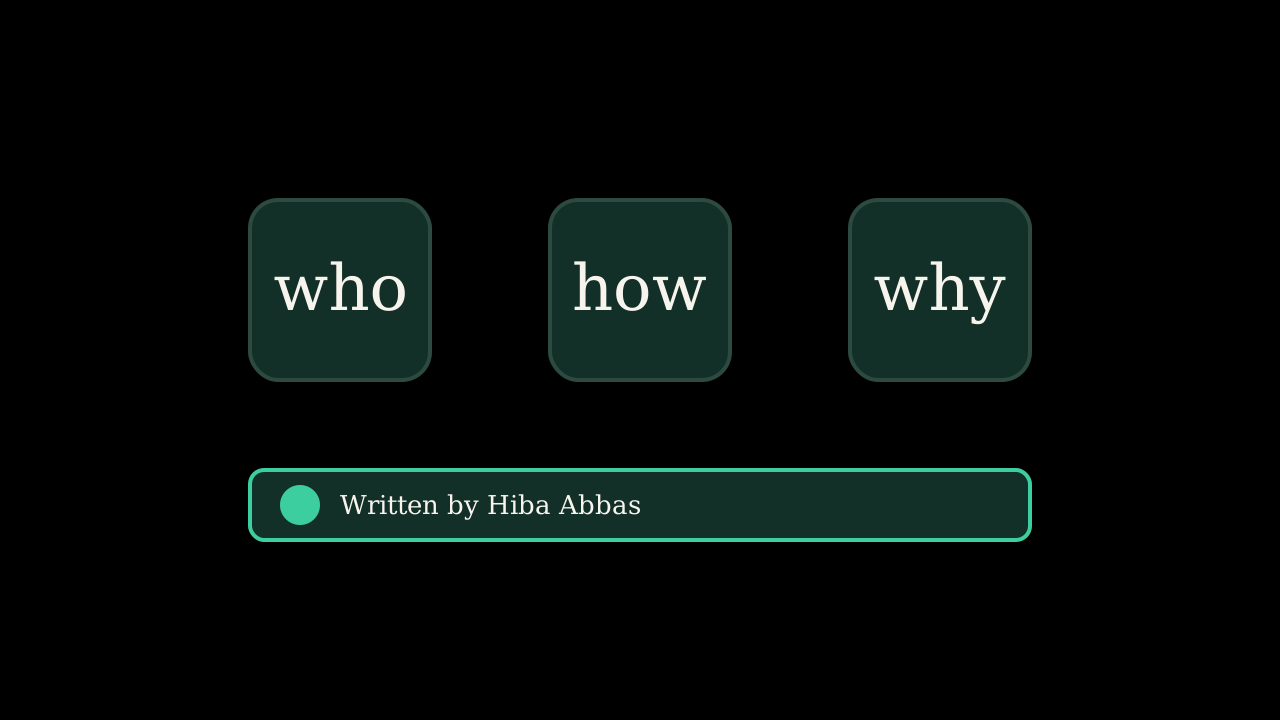
Google frames the self-assessment as who, how, and why.
Who made the content. Is it clear? Is there a byline, and does it lead somewhere? On this site every article carries a byline, the About page says what I have shipped, and the structured data names the same person on every post. That is not clever. It is the minimum for the who question to have an answer.
How was it made. Google's guidance is that explaining the process is useful where readers would reasonably expect it, and that includes disclosing automation or AI where it would matter to them. Its line on the technology itself, from the AI content post, is that appropriate use of AI or automation is not against the guidelines, and that the problem is using it to generate content primarily to manipulate rankings. The how question is the one every publisher has to be deliberate about now, and it is the one this site's README rule answers only partly: it says what may be written, not how.
Why it exists. Google calls this perhaps the most important question. Content made to help people who arrive at it is the goal. Content made primarily to attract visits from search engines is the opposite, and if automation is used for that purpose it is spam.
The rule, run through the questions
“Only write what you actually did or saw” answers who and why in one stroke. If I only publish what I did, the author is necessarily the person who did it, and the reason the page exists is that something happened and someone else might hit it too. The eight rejections post exists because I was rejected eight times. It could not have been written to rank first.
Where the rule strains is on posts like this one, and like the rest of this week's batch on Google's documentation. I did not “do” a core update. What I did was read the primary source and check it against a real site, and the value in the post is the checking, not the summary. Google's own quality questions ask whether the content provides original information, reporting, research, or analysis, or whether it is copying or rewriting other sources. A post that says what Google's document says is a rewrite. A post that says what it means for a site with twenty-eight URLs, a 3D homepage, and a GPTBot rule is analysis. I am trying to stay on the second side of that line, and readers are allowed to judge whether I do.
The other questions worth stealing
Google's list is long. The ones I now ask before publishing:
- Would you bookmark this, share it with a friend, or recommend it?
- Does the title describe the content, or exaggerate it?
- Does the page leave people feeling they learned enough, or that they need to search again?
- Is it free of the kind of sloppiness that suggests it was produced in a hurry?
That last one is the presentation question, and it is why I would rather publish fewer posts than post the same day I drafted.
What I am not going to do
Add an “E-E-A-T section.” Put credentials in a box. Write “as an expert” anywhere. None of that is what the document asks for, and all of it is the kind of thing that reads as made for a system rather than a person, which is the exact failure the page is describing.
Sources: Google Search Central, “Creating helpful, reliable, people-first content.” Google Search Central Blog, “Google Search's guidance about AI-generated content,” February 2023.