Google published a short post on August 28 called “Update to the Site Reputation Policy.” It is the first time I have seen a ranking penalty that depends on where the searcher is sitting.
What the policy is
Site reputation abuse is the practice big publishers got caught doing in 2024: renting out a section of a trusted domain to third-party content, usually coupon codes or product roundups, so that content ranks on the host's reputation rather than its own. Google's definition is that the policy “applies where third-party content is published on a host site mainly because of that host's already-established ranking signals, which it has earned primarily from its first-party content.”
The enforcement has always been a manual action. A human at Google flags the section, the site gets a notice in Search Console, and that section drops.
What changed on August 30
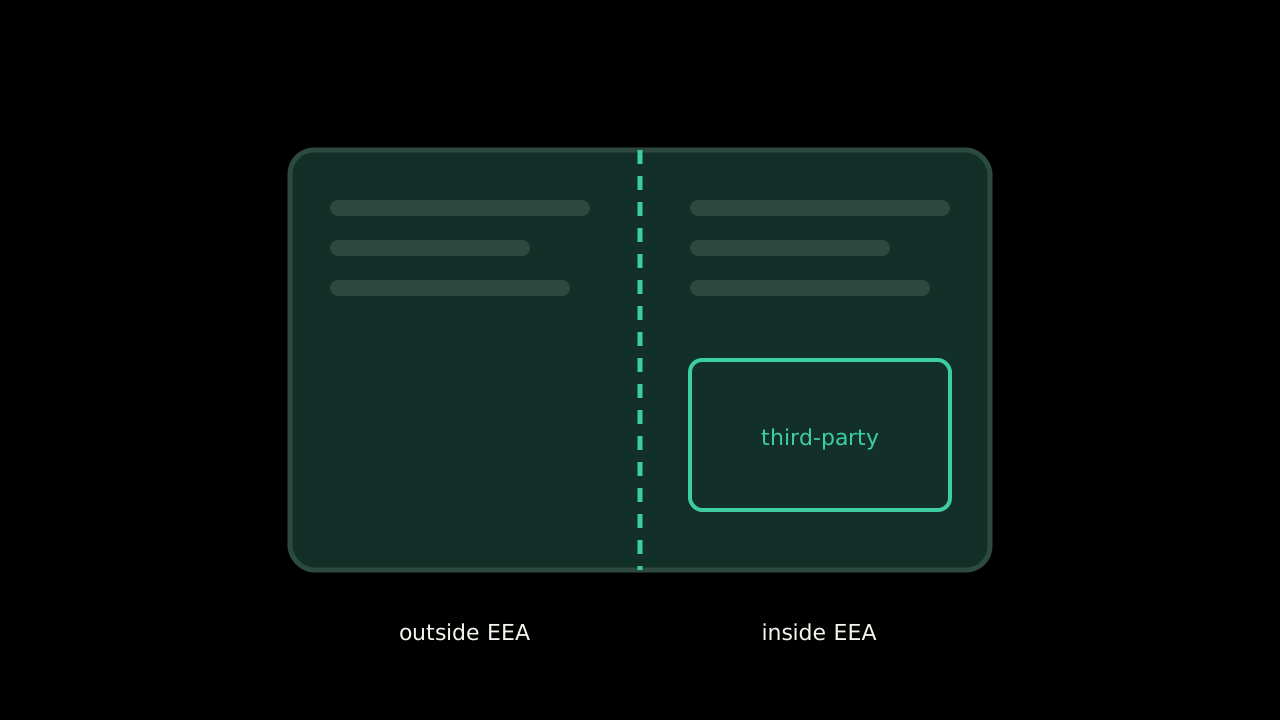
After discussions with the European Commission, Google split the effect of that manual action in two.
Outside the European Economic Area, nothing changed. A manual action affects the flagged portion of the site for searchers there, and the rest of the site is untouched.
Inside the EEA, the manual action does not apply. Instead the flagged content is separated within Google's systems so that it ranks on its own merits, as if it were not on the host domain, against similar content elsewhere. Manual actions that were already in place under this policy were lifted for EEA users.
Site owners still get the Search Console notice, can still file a reconsideration request, and eligible sites can now take a dispute to mediation after reconsideration.
So the same coupon page can be demoted for someone searching in Karachi and ranked independently for someone searching in Berlin. That is new.
The four criteria Google wrote down
The more useful part of the post, for anyone who is not a large publisher, is that Google listed what it looks at when deciding whether third-party content is riding a host's reputation:
- Presentation. Is the third-party section presented consistently with the rest of the site, or is it visibly bolted on?
- Quality. Does the content meet the standard the host is known for?
- Authorship. Is it clear who wrote it and what their relationship to the host is?
- Duplication. Does the same content appear elsewhere, under other hosts?
Why this matters for a site with one author
This site has one author. Nothing here is third-party. On paper the policy cannot touch it.
But sooner or later someone asks whether a site takes guest posts, and until now I did not have a rule for answering. Now I do, and it is Google's list. If I ever say yes, the post has to look like the rest of the site, hold to the same standard, carry a real byline with the relationship stated, and not exist anywhere else. That is a high enough bar that most guest post pitches fail it in the first email.
The same list is worth applying in the other direction. If someone offers to publish my writing on a bigger domain, the question is whether it would be there because it is good or because the domain ranks. If the answer is the second, it is exactly the arrangement the policy is built to catch.
What I would watch
If you publish in the EEA and have a section that could be read as third-party, the change does not make it safe. It changes the mechanism from a penalty to a separation. Content that was ranking on borrowed reputation will now have to rank on its own, and for most of that content, its own is not much.
Sources: Google Search Central Blog, “Update to the Site Reputation Policy,” August 28, 2026. Google Search Central, spam policies, site reputation section.