Earlier today I published five articles in one sitting. Then I read Google's spam policies, and one line made me sit up:
Using generative AI tools or other similar tools to generate many pages without adding value for users.
That is one of the examples under scaled content abuse. It is worth knowing exactly where the line is, because the spam updates that enforce it have been running all year.
The three updates, by the dashboard
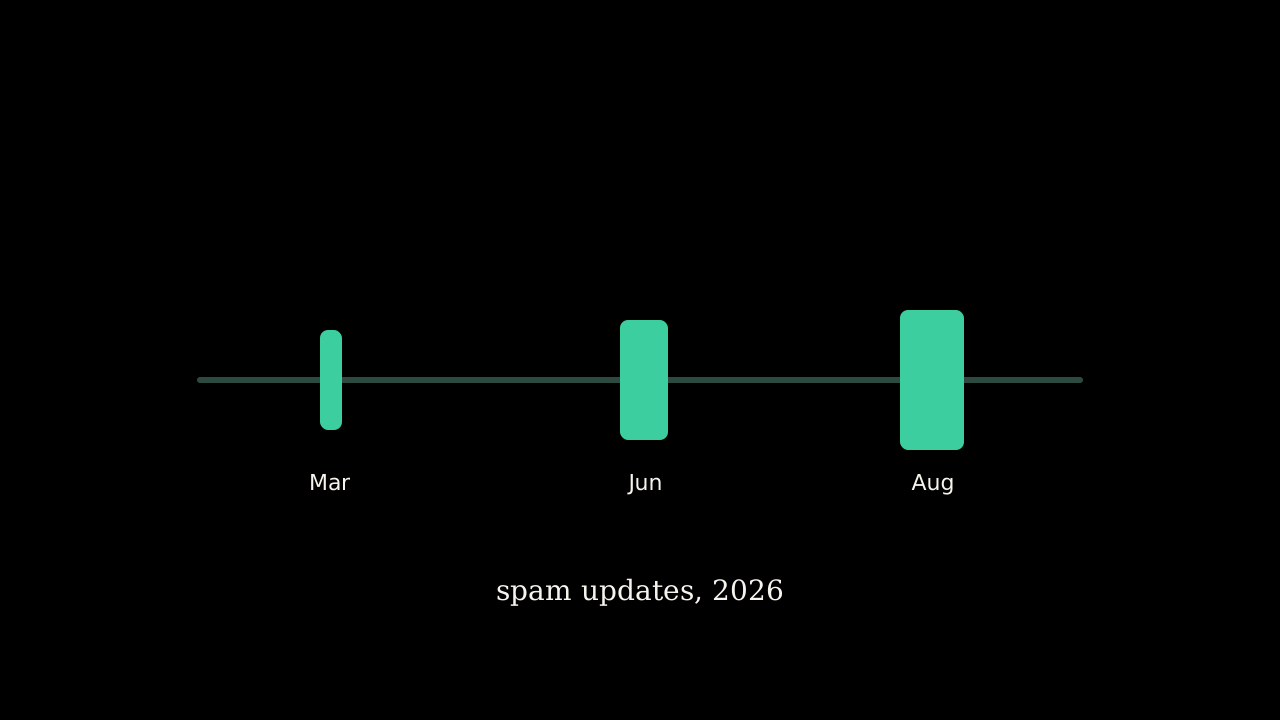
Google's Search Status Dashboard lists every ranking update with a start time and a duration. For 2026 the spam entries are:
| Update | Started | Ran for |
|---|---|---|
| March 2026 spam update | March 24 | 19 hours 30 minutes |
| June 2026 spam update | June 24 | 2 days 1 hour |
| August 2026 spam update | August 18 | 2 days 16 hours |
Compare that to the two core updates, which took twelve and eleven days. Spam updates are fast because they are not re-weighing quality. They are applying a classifier to things the policies already define.
What the policies define
The spam policies page is the actual rulebook, and it is shorter than most articles about it. The ones that matter for a small content site:
Scaled content abuse is “when many pages are generated for the primary purpose of manipulating search rankings and not helping users.” The examples are generating many pages with AI or other tools without adding value, scraping and lightly transforming other people's content, and stitching pages together from multiple sources.
Expired domain abuse is buying a lapsed domain and using its history to rank content “that provides little to no value to users.”
Site reputation abuse is third-party content published on a host “mainly because of that host's already-established ranking signals.” That one changed at the end of August, and it gets its own post.
Back button hijacking was added to the malicious practices section on April 13, 2026. It is “when a site interferes with user browser navigation by manipulating the browser history” so the back button does not take people where they came from. If you have ever landed on a page that needed three back presses to escape, that is now a named spam practice.
Reading my own week against that
Five posts in a day is a number. The policy does not care about the number. Every definition above turns on two words: purpose and value.
The test I applied is the one the policy implies. Would each of those pages exist if search did not? The App Store social media question is something anyone submitting an app this month has to answer. Multiseat purchasing is on by default in App Store Connect right now. Android developer verification has a date six days out. Those pages have a reason to exist that is not “rank for a phrase.” If I could not name that reason for a post, I would not publish it, and no amount of rewriting would fix it.
The other tell is whether the content is mine. Scraped-and-transformed is the pattern the policy names most often. A post that reads a Google document and says what it means for one specific site is not that. A post that reads three roundups and averages them is closer to it than I would like.
What I am not worried about
Volume on its own. Google has been explicit that it is not about how content is produced or how much of it there is. It is about whether the pages are made for people. A site can publish twenty useful things in a day and be fine. A site can publish one page a month made for a ranking and not be.
The habit that comes out of this
Before I publish, I say in one sentence who the page is for and what they can do after reading it. If the sentence is “people searching for X,” it fails. If it is “anyone with an app update queued this month, so they open the age rating section first,” it passes.
That is not an SEO trick. It is the policy, applied before Google applies it.
Sources: Google Search Status Dashboard, ranking updates history. Google Search Central, “Spam policies for Google web search.” Search Central documentation updates, April 13, 2026.